Newbe wanted to post that in 1970's and 1980's HK shipped original hunting rifles as follows in the G3 TYPE delay roller blow back systems:
270-300 .22 cal
630 - .223 cal
770- .308 cal
950- 30.06 cal
SL 6,- .223 cal
SL 7- .308
Here is brief history:
SL-6 & SL-7 rifles were developed by German company Heckler & Koch during early 1980s after the HK 630, 770 &940, as a para-military weapons for training reservists and possibly arming police. Those rifles, which differed only in calibers / ammunition used (5.56mm for SL-6 and 7.62mm for SL-7) were based on hunting rifles from the same company, the HK 630 and HK 770 respectively, sharing same roller-delayed blowback action and general layout, but featuring shorter barrels and military-type sights and furniture (sling swivels, steel buttplates etc).
Due to high price and German gun laws limitations, overall production of SL-6 and SL-7 rifles was limited and now those weapons are collector's items. Say 50% more than HK 770! The HK SL-6 and SL-7 rifles use roller-delayed blowback action, similar to that used in HK G3 rifle. Chamber is fluted to assist extraction. The cocking handle is located on the right side of the receiver (as opposed to HK G3),and folds forward when not in use. Manual safety is located on the left side of the stock, above and in the front of the trigger. Feed is from proprietarynn detachable box magazines, holding 3 (flush-fit) or 10(extended) rounds. Stock is made of wood, with additional wooden handguard (ventilated on SL-7) and steel buttplate. Standard sights include hooded front post on the barrel and drum-type diopter sight(similar to that used on HK G3 & 91,94),with settingsfrom 100 to 400 meters in 100-meter increments. Receiver is fitted with mounting points for proprietary HK scope mounts. SL-7 magazines are interchangeable with 770.Replaced by SLB.(SPORT SCOPE MOUNTS - H&K 300/630/770/940/SL6/SL7 - SM4300-main office 5597 Oak St, Fort Worth, TX 76140, USA (817) 783-6001 http://sunopticsusa.com/ $42. See below for details.Most importantly the HKxxx series has free floated barrels, the SLx series does not. Free floated barrel is proven superior for accuracy.
Best Roller-Delayed Blowback Guns
Now that we’ve talked a little about how these guns work, as well as some pros and cons, let’s look at the guns themselves. So, there aren’t a ton of rollies out there. But some iconic roller-delayed blowback options do exist on the market. Just over 40 years after the first roller delayed battle rifle entered service, Heckler and Koch decided to create an autoloading hunter’s rifle for the civilian market. Luckily, the CETME and G3 actions were being produced in massive numbers and it was just a matter of creating a new set of furniture for the civilian market in which to place the same recoil mechanism.
Heckler and Koch model SL-7 was just that: a stated hunting rifle utilising the exact same roller delay operating system as the CETME and G3. This more modern autoloader models itself quite close to the original Gewehr 43 in aesthetics with a similar front nosecap keeping the upper hand guard pressed into the receiver. With available 10 round magazine, an untrained eye could quite easily mistake the two.
Later in production, HK created the HK 770 which are hunting variants using a traditional, unmistakable European rifle stock making more use of the lack of front charging handle placement to completely remove all the front wood allowing for a free floated barrel. Later on, HK added the SL-6 which was a full wood version of the SL-7 but in .223 and the HK940 which was a sporter style HK 770 but in .30-06 instead.
The biggest and most notable changes that HK did when creating a new receiver and upper for the SL-7 series rifles was the relocation of the charging handle backwards and on the right side of the receiver and creating an entirely new magazine. The charging handle relocation made the rifle significantly thinner and much less unwieldy and shaved off over one lb from the dry weight. The bolt does not lock open on the final round but can be locked back to the rear similar to the G3 locking mechanism but releasable with the user’s right thumb instead. The magazine change opted instead for a double feed 3 and 10 round magazine built entirely of steel. This also allowed the Cartridge Overall Length (COAL) to be increased from a paltry 2.820 inches (7.16 cm) for the G3 / 91 magazines to over 2.940 inches (7.45 cm) allowing the use of much longer and heavier .308 rounds.
The magazine upgrade along with a significantly better trigger allows this rifle to get sub MOA at 100 yards with appropriate ammo (as long as you do your job). However, the shorter receiver and metal backing plate without a large stock mounted buffer means the rifle suffers a similar issue with the Gewehr-43 in that the bolt recoils quite hard into the rear bolt stop and receiver. HK seemed to have rectified this by placing a pretty hard buffer at the rear but as this is a blowback rifle (despite being roller delayed), it would be advised to watch the firearm’s usage using any hot handloads.
Generally, one would want to avoid grainage over 168 due to the twist rate anyway as the SL-7 and all variants use the same 1:11 polygonal twist rate barrel hydraulic pressed into the receiver with varying barrel lengths depending on factory specifications. HK also did a fantastic job with the quick detach, upper claw mounts for a scope providing both a lever release and a two screw release option. I’ve personally found a benefit using the SL-7 being the only one shooting PRS who can field swap scopes and hold a zero in the middle of a match! With the last batch allegedly being made in the early 1990s, HK largely abandoned the production of these rifles allowing them to be quite collectible and obscure rifles today. No exact figures would exist for total number produced but these have quite a niche within certain states and countries where assault style rifles may have or receive a potential prohibition.
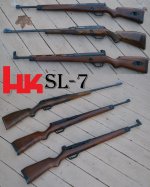
Pictured below upper SL6 &7: below 630,770_940. My 98% 770
270-300 .22 cal
630 - .223 cal
770- .308 cal
950- 30.06 cal
SL 6,- .223 cal
SL 7- .308
Here is brief history:
SL-6 & SL-7 rifles were developed by German company Heckler & Koch during early 1980s after the HK 630, 770 &940, as a para-military weapons for training reservists and possibly arming police. Those rifles, which differed only in calibers / ammunition used (5.56mm for SL-6 and 7.62mm for SL-7) were based on hunting rifles from the same company, the HK 630 and HK 770 respectively, sharing same roller-delayed blowback action and general layout, but featuring shorter barrels and military-type sights and furniture (sling swivels, steel buttplates etc).
Due to high price and German gun laws limitations, overall production of SL-6 and SL-7 rifles was limited and now those weapons are collector's items. Say 50% more than HK 770! The HK SL-6 and SL-7 rifles use roller-delayed blowback action, similar to that used in HK G3 rifle. Chamber is fluted to assist extraction. The cocking handle is located on the right side of the receiver (as opposed to HK G3),and folds forward when not in use. Manual safety is located on the left side of the stock, above and in the front of the trigger. Feed is from proprietarynn detachable box magazines, holding 3 (flush-fit) or 10(extended) rounds. Stock is made of wood, with additional wooden handguard (ventilated on SL-7) and steel buttplate. Standard sights include hooded front post on the barrel and drum-type diopter sight(similar to that used on HK G3 & 91,94),with settingsfrom 100 to 400 meters in 100-meter increments. Receiver is fitted with mounting points for proprietary HK scope mounts. SL-7 magazines are interchangeable with 770.Replaced by SLB.(SPORT SCOPE MOUNTS - H&K 300/630/770/940/SL6/SL7 - SM4300-main office 5597 Oak St, Fort Worth, TX 76140, USA (817) 783-6001 http://sunopticsusa.com/ $42. See below for details.Most importantly the HKxxx series has free floated barrels, the SLx series does not. Free floated barrel is proven superior for accuracy.
Best Roller-Delayed Blowback Guns
Now that we’ve talked a little about how these guns work, as well as some pros and cons, let’s look at the guns themselves. So, there aren’t a ton of rollies out there. But some iconic roller-delayed blowback options do exist on the market. Just over 40 years after the first roller delayed battle rifle entered service, Heckler and Koch decided to create an autoloading hunter’s rifle for the civilian market. Luckily, the CETME and G3 actions were being produced in massive numbers and it was just a matter of creating a new set of furniture for the civilian market in which to place the same recoil mechanism.
Heckler and Koch model SL-7 was just that: a stated hunting rifle utilising the exact same roller delay operating system as the CETME and G3. This more modern autoloader models itself quite close to the original Gewehr 43 in aesthetics with a similar front nosecap keeping the upper hand guard pressed into the receiver. With available 10 round magazine, an untrained eye could quite easily mistake the two.
Later in production, HK created the HK 770 which are hunting variants using a traditional, unmistakable European rifle stock making more use of the lack of front charging handle placement to completely remove all the front wood allowing for a free floated barrel. Later on, HK added the SL-6 which was a full wood version of the SL-7 but in .223 and the HK940 which was a sporter style HK 770 but in .30-06 instead.
The biggest and most notable changes that HK did when creating a new receiver and upper for the SL-7 series rifles was the relocation of the charging handle backwards and on the right side of the receiver and creating an entirely new magazine. The charging handle relocation made the rifle significantly thinner and much less unwieldy and shaved off over one lb from the dry weight. The bolt does not lock open on the final round but can be locked back to the rear similar to the G3 locking mechanism but releasable with the user’s right thumb instead. The magazine change opted instead for a double feed 3 and 10 round magazine built entirely of steel. This also allowed the Cartridge Overall Length (COAL) to be increased from a paltry 2.820 inches (7.16 cm) for the G3 / 91 magazines to over 2.940 inches (7.45 cm) allowing the use of much longer and heavier .308 rounds.
The magazine upgrade along with a significantly better trigger allows this rifle to get sub MOA at 100 yards with appropriate ammo (as long as you do your job). However, the shorter receiver and metal backing plate without a large stock mounted buffer means the rifle suffers a similar issue with the Gewehr-43 in that the bolt recoils quite hard into the rear bolt stop and receiver. HK seemed to have rectified this by placing a pretty hard buffer at the rear but as this is a blowback rifle (despite being roller delayed), it would be advised to watch the firearm’s usage using any hot handloads.
Generally, one would want to avoid grainage over 168 due to the twist rate anyway as the SL-7 and all variants use the same 1:11 polygonal twist rate barrel hydraulic pressed into the receiver with varying barrel lengths depending on factory specifications. HK also did a fantastic job with the quick detach, upper claw mounts for a scope providing both a lever release and a two screw release option. I’ve personally found a benefit using the SL-7 being the only one shooting PRS who can field swap scopes and hold a zero in the middle of a match! With the last batch allegedly being made in the early 1990s, HK largely abandoned the production of these rifles allowing them to be quite collectible and obscure rifles today. No exact figures would exist for total number produced but these have quite a niche within certain states and countries where assault style rifles may have or receive a potential prohibition.
Pictured below upper SL6 &7: below 630,770_940. My 98% 770